
A diamond hole saw looks simple: a hollow cylinder with diamond on the cutting edge. Pick the wrong type, then you get chipped tile, a cracked glass panel, or a saw that wears out after a few holes. The material decides the tool. Here is how to match the hole saw to the job.
Before comparing prices or sizes, answer three questions. What material will you cut — tile, glass, stone, concrete, or metal? Will you need wet cutting or dry cutting? And what machine will drive the saw — an angle grinder or a portable drill?
Tile and porcelain are hard and brittle, and need a saw that cuts cleanly without chipping the glazed surface. Glass is even more unforgiving: too much pressure or heat, it cracks. Concrete and stone are abrasive and demand a tougher bond. Metal needs a completely different cutting edge.
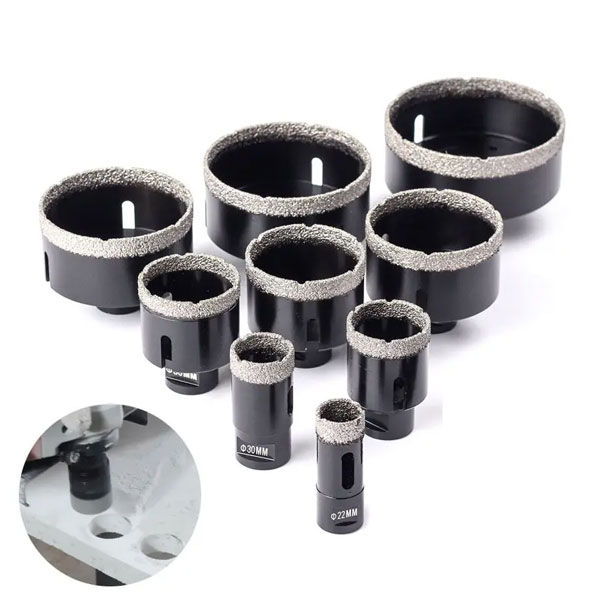
A vacuum brazed diamond hole saw has diamond grit bonded directly to the steel body in a vacuum furnace. There is no thick metal rim holding the grit, so the saw cuts fast, and the open U-shaped chip grooves clear debris instead of letting it pack into the cut.
It is the most versatile choice for tile, porcelain, stone and concrete. It works dry or wet, and a little water makes the cut smoother and extends its life. The version we supply uses an M14 thread and fits an angle grinder.
Start the hole at about a 45-degree angle so the edge bites instead of skating across the surface, then straighten to 90 degrees once the cut has started. Let the diamond do the work — heavy pressure only builds heat and shortens the life of the saw. If you want one saw that covers most tile, porcelain and concrete jobs, start here: Vacuum Brazed Diamond Hole Saw

An electroplated diamond hole saw has a single layer of diamond grit plated onto a steel body. That thin, even layer is its advantage on delicate materials. It cuts with very little pressure, leaves a smooth edge, and drills glass without exit chipping.
Choose it for glass, mirrors, and thin ceramic tile, especially when the finish around the hole will stay visible. Our electroplated saw is made from steel and diamond, comes in sizes from 3 mm to 180 mm, with a 10 mm working length, and has a round shank with a water hole. It fits any portable electric drill.
Use water, keep the speed moderate, and let the saw cut at its own pace. Forcing the tool is the fastest way to crack glass. For glass and fine tile work, see our Electroplated Diamond Hole Saw for Glass

Tungsten carbide tipped (TCT) hole saws look similar, but they are built for a different job. The carbide teeth cut metal — stainless steel up to 3 mm, iron plate up to 5 mm, aluminium alloy up to 5 mm, and metal tube — where a diamond saw would be wasted.
The set we supply is made from industrial-grade TCT carbide steel, with a three-edged combined tooth design that keeps cutting resistance low. Drill bit, spring and wrench are included, and it works on hand-held, bench, magnetic and pneumatic drills. Double round grooves clear metal filings, and a lubricant — water or oil — keeps the bit cool.
Do not use a TCT saw on tile or glass, and do not use a diamond saw on metal. Each edge is designed for its own material. If your holes are in metal, choose the TCT Hole Saw
There is no single best diamond hole saw — there is a best one for your material. Vacuum brazed for tile, stone and concrete; electroplated for glass and fine tile; TCT for metal. Match the saw to the material, add water, and let the cutting edge do the work.
If you are unsure which type fits your job, tell us the material, the hole size and the machine you will use, and we will recommend the right one.
Contact: Michael
Phone: +86 14757020050
Tel:
Email: info@nbstrivers.com
Add: Room 506, Building 12, Lane 299, Guanghua Road, High-tech Zone, Ningbo City, Zhejiang Province